Racism is a combination pf historical, economic and psychological factors designed to maintain power, justify exploitation and foster ingroup loyalty. Are you a racist? Determining if you hold racial views or biases requires honest self-reflection.
Racism is prejudice, discrimination or antagonism directed against individuals or groups of a different race or ethnic background based on the belief that one’s own race if superior. Therefore, domination and exploitation of the inferior race or group is justified.
Is the United States a racist country? Sociological consensus indicates that throughout U.S. history, white supremacy and systemic discrimination have advantaged white Americans while negatively impacting Black people, Native Americans, Hispanics, Middle Easterners and Pacific Islanders. Racism is embedded in policies, laws and institutions causing socioeconomic inequality in sectors like housing, healthcare, criminal justice, employment and voting rights.
Statistical data on racially motivated incidents indicates that Black Americans remain the most frequently targeted group for hate crimes. High-profile cases of police brutality and racial tensions show that racism remains an ongoing issue in daily activities.
Before 1865, most African Americans were enslaved. Since the abolition of slavery, they have faced severe restrictions in their political, social and economic freedoms.
In the view of the United Nations and the U.S. Human Rights Network, “discrimination in the United States permeates all aspects of life and extends to all communications of color.”
The 15th Amendment to the Constitution ratified in 1870 prohibited denying the right to vote based on race. However, the Compromise of 1877 ended the era of strong enforcement of equal rights in the Southern states. Jim Crow laws included poll taxes, literacy and comprehension tests and record-keeping requirements. Black codes criminalized minor offenses like unemployment (vagrancy) to deny voting rights.
The Voting Rights Act of 1965 was enacted to enforce the 15th Amendment to the Constitution. It outlawed discriminatory voting practice such as literacy tests and poll taxes that were widely used to disenfranchise racial minorities.
In Shelby County v. Holder (June 2013) the Supreme Court struck down Section 4 of the Voting Rights Act that had required states with documented history of racial discrimination to secure federal approval before changing their election laws.
In Brnovich v. Democratic National Committee (March 2022), the court significantly narrowed section 2 of the Voting Rights Act. This forced plaintiffs challenging restrictive voting rules to prove discriminatory intent rather than just a discriminatory effect making it much harder to successfully sue states over laws that disproportionately affect minority voters.
In Louisiana v. Collais (April 2026), the count issued a 6-3 decision ruling that Louisiana’s congressional map relied too heavily on race when it created a second minority black district. This severely limited how race can be used to ensure minority voters can elect candidates of their choice.
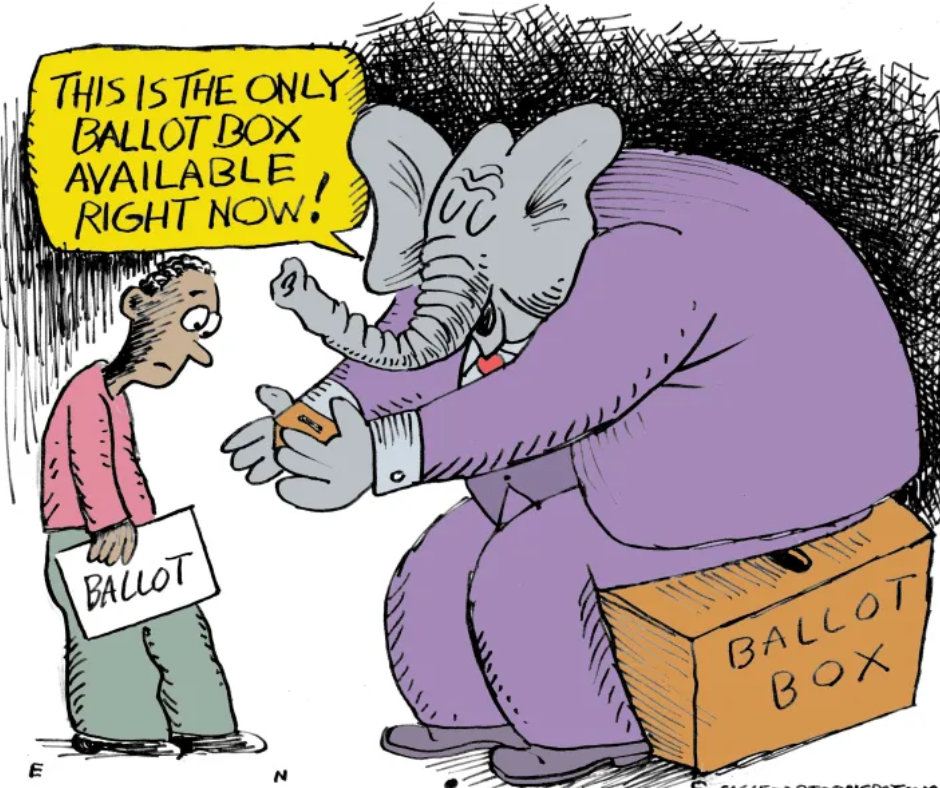
There are significant ongoing legal battles over congressional maps and voter suppression. Policies such as stringent voter ID laws, purging of voter rolls and gerrymandering frequently target areas populated by minority groups.
Voter suppression is the lack of polling places in highly concentrated minority communities with hours of wait time; it is voter laws stating those on probation cannot vote; and it is political figures pushing baseless claims of voter fraud against people of color.
Racially gerrymandering is considered a form of racism because it deliberately manipulates electoral district boundaries to disadvantage or dilute the voting power of racial or ethnic groups.
The purpose of redistricting is that elections are free, fair and representative of all the people. The process requires that every 10 years after the national census congressional state and local districts are redrawn, if necessary, to reflect changes in population to ensure that district populations are equal. However, this is not what is happening at this time. The Party of Trump (formerly the Republican Party) is redrawing maps now to favor Republican candidates with the hope of keeping the Party of Trump as the majority party following the November midterm elections.
Racism is a combination pf historical, economic and psychological factors designed to maintain power, justify exploitation and foster ingroup loyalty. Are you a racist? Determining if you hold racial views or biases requires honest self-reflection.
Carol Pomeroy lives in Salisbury.