Previously, voting maps only changed once a decade. That mandate has been blown out of the water in North Carolina. The soldiers in Raleigh have changed voting maps seven times in nine Years. The North Carolina legislature passed a mid-decade map in October 2025, adjusting the districts from a balanced 7-7 “purple” configuration to a 10-4 “red” configuration. Recently, they adjusted again hoping to get an 11-3 distribution.
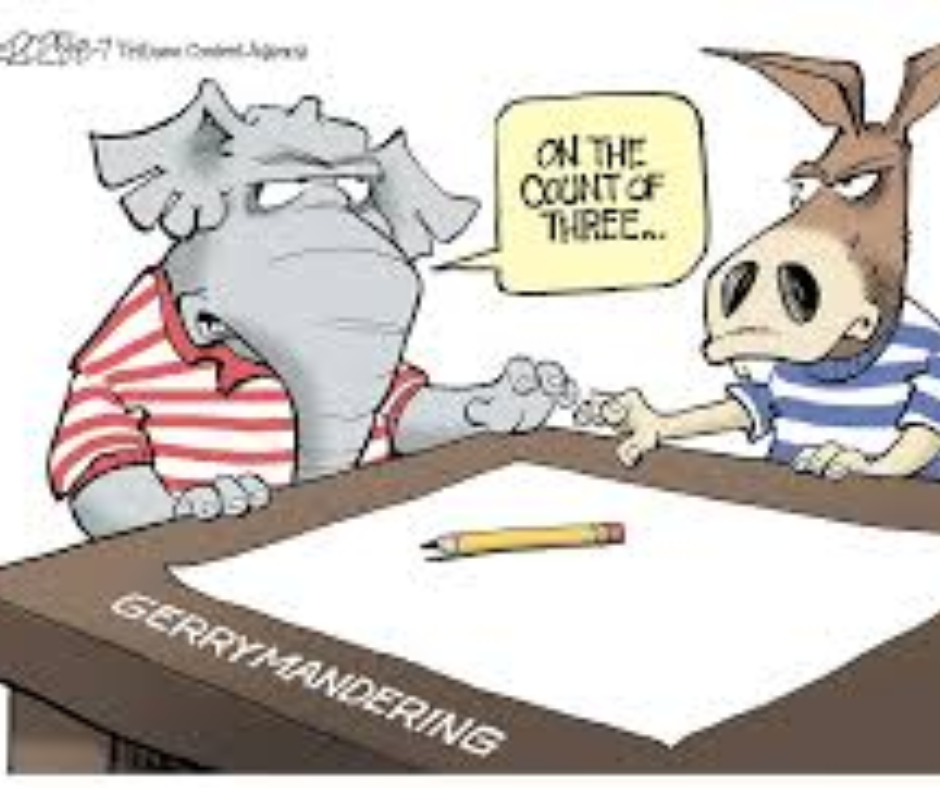
Both political parties have weaponized gerrymandering to give them an advantage in district elections. This year, it’s especially extreme in the U.S. congressional mid-terms because the political wonks and pundits are predicting the Democrats are likely to take over the House of Representatives.
It’s open war because the legislators in many states set district boundaries. States with Republican majorities get their Sharpies out and carve out districts to offset their party’s demise in November. Democrats fight back with Magic Markers. Nowhere is it more apparent than in Texas and California. Texas shot the opening volley with a plan that could add Republican seats.
California voters passed Proposition 50 which proposes new lines for many of California’s 52 congressional districts, which would negate the five Republican seats drawn by Texas. Under the proposed lines, Democrats could gain up to 5 seats in the U.S. House of Representatives. With a majority in the House, Democrats can fight back against Trump and Republicans.
So, what’s with the lizards?
The term “gerrymandering” was coined in 1812 from a combination of Massachusetts Governor Eldridge Gerry’s last name and a salamander. That’s because Eldridge, a Democrat, introduced a bill that redrew the state’s legislative districts to favor his party. The result was some districts were narrow and slinky, like a salamander. Republicans took it a step farther claiming the districts looked like a mythical lizard.
Some have called the current situation “a race to the bottom.”
Case in point: On April 26, Virginia voters held a special election that would have added as many as four congressional seats for Democrats. The Republican-controlled Supreme Court handed down a 4-3 decision declaring the election as unconstitutional, thus nullifying the election.
Three days later, the U.S. Supreme Court put its thumb on the scale when it issued a 6-3 decision that effectively gutted Section 2 of the Voting Rights Act of 1965, removing key protections against racial discrimination in voting. This ruling followed a major 2013 decision in Shelby County v. Holder that struck down the act’s preclearance formula, with earlier challenges in 1966 and 1969 having which initially upheld the law.
The war has escalated. Precision-guided cruise missiles have been launched.
The Republican-controlled state legislatures in Louisiana, Tennessee, Alabama and South Carolina are now considering redistricting pl the U.S. Congressional maps in their states.
The battle lines have been drawn in North Carolina too.
Previously, voting maps only changed once a decade. That mandate has been blown out of the water in North Carolina. The soldiers in Raleigh have changed voting maps seven times in nine Years. The North Carolina legislature passed a mid-decade map in October 2025, adjusting the districts from a balanced 7-7 “purple” configuration to a 10-4 “red” configuration. Recently, they adjusted again hoping to get an 11-3 distribution.
Dr. Michael Bitzer, a professor of politics and history at Catawba College, told the Salisbury Post: “What we are seeing is not just extreme gerrymandering, but gerrymaxxing, or pushing the real limits of partisan redistricting. This form of political warfare was unleashed thanks to a North Carolina case — Rucho v. Common Cause in 2019 — and now, with the constraints placed on the Voting Rights Act, one-party controlled states are wiping out the opposition in congressional delegations by the drawing of district lines.”
That said, it’s in to the trenches. Dr. Bitzer adds, “In states where Democrats control the process, they are going full bore ahead, just as Republicans are in their states (VA is an interesting state where things went sideways due to procedural issues). See California.
Otherwise, it’s all about turning out their voters at this point and pushing some R+5 seats into competitive status, Bitzer concludes.
When it’s all been said and done, Trump’s not-so-hidden agenda is to sow doubt in the electoral process and invalidate elections. Could this be another step toward fascism?
John Jeppesen lives in Rowan County.