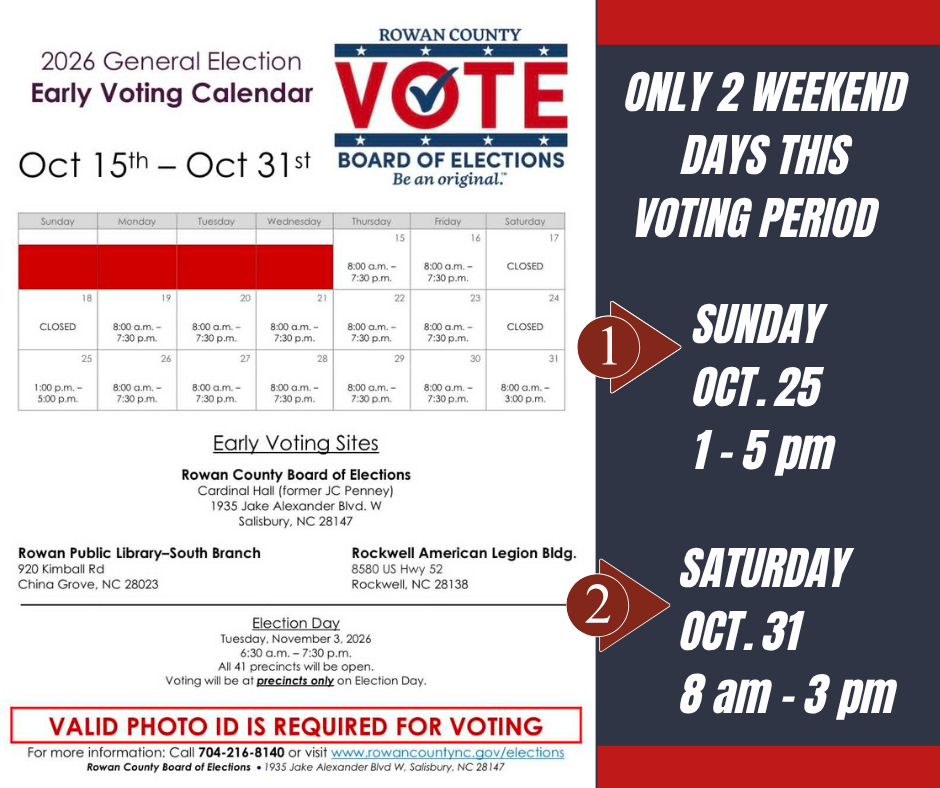
It’s important for all of us to continue the work to defend the vote of the people. Start by making a plan to vote on Sunday, October 25th, from 1 – 5 pm, and encourage others to vote. Together, we make change happen. YOU make a difference! Or as Sailor Jones says of college students who lost their campus voting locations this year, “they are now turning the timely Pauli Murray quote, ‘don’t get mad, get smart,’ into a rallying cry for student turnout.”
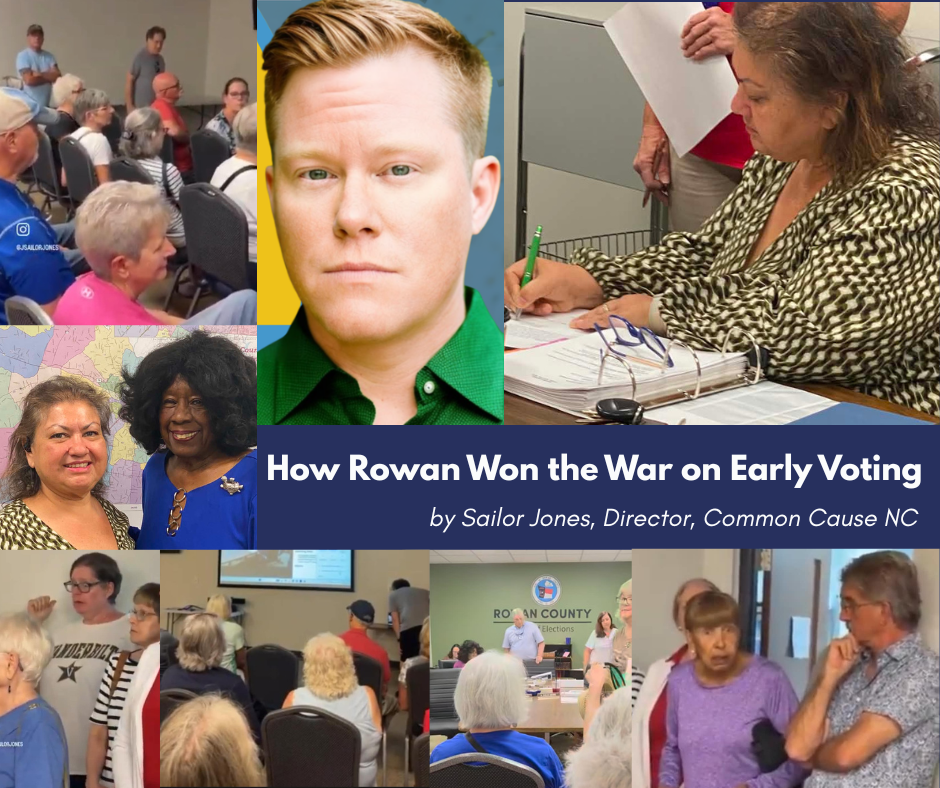
A thank you to Rowan County voting advocates for accessible voting for ALL voters from Common Cause NC’s director, Sailor Jones, center in green. Center left, Rowan Democratic Election Board members, Evelyn Medina and Dee Dee Wright and a sample of our community voting advocates.
Warmest regards, The Two Nanas, Pam & Nan
How Rowan Won the War on Early Voting – Sailor Jones
Rowan Board of Elections Member Evelyn Medina may not have known it at the time, but her remarks at last month’s State Board of Elections meeting revealed just how North Carolina’s people, not its politicians, will win the war on early voting.
The State Board met Aug. 20 to determine 2026 early voting plans for 20 counties where local boards like Rowan’s couldn’t agree. It followed months of contentious county debates over sites and hours often dictated by Republican county elections chairs hand-picked by GOP Auditor Dave Boliek.
Public records requests revealed that throughout the local processes to make early voting picks, Boliek was consistently pressuring county chairs to ignore public input and instead produce rigged plans favorable to Republican interests.
The rub in Rowan that Medina traveled to Raleigh to address was a common one. GOP majorities on five-person county elections boards largely wanted to shift away from options used in prior elections. Democratic minorities mostly wanted to save or add options in anticipation of a high-turnout midterm.
Medina, a Democrat, spoke after Rowan Republican Elaine Hewitt made her case for the majority’s plan to cut Saturday and Sunday options used in 2022. Ms. Hewitt was there to stand in for Dave Collins, one of many GOP county board of elections chairs who skipped the board meeting rather than face scrutiny for colluding with the State Auditor’s office.
But during her testimony at the State Board meeting, Ms. Medina ignored the auditor’s influence. Instead, she emphasized her bipartisan efforts with Hewitt to increase voter participation, telling the State Board that this year’s early voting plans should reflect the electorate Rowan’s leaders had been working across the aisle to grow.
To make the case to save Saturday and Sunday voting, Medina reminded State Board Chair Francis DeLuca of what he told elections officials from all 100 counties during August’s annual State Board conference: “our mission is to make early voting easy.”
“As more voters are engaged, early voting will help to keep lines shorter on the day of elections, and this will make it, guess what? Easier,” Medina told DeLuca.
From there, Ms. Medina provided a masterclass in what it means to put people over politics. She advocated compassionately and convincingly to expand weekend options for “Individuals who only have weekends off, residents who rely on others for rides; commuters who work far away from home, and workers who cannot afford to take unpaid time off,” regardless of political party or preference.
After months of uncharacteristically toxic debates over early voting cuts, Medina’s peaceable exchanges with Hewitt and the GOP-led State Board were a calming salve that called back to a bygone era in North Carolina politics. Her words were also a reminder that the vast majority of Republicans and Democrats support Sunday and campus voting, the very options at stake for too many counties this year.
The contrast couldn’t have been clearer: while the auditor had demanded that counties produce early voting plans that “GOP voters need,” Medina made the case for what all voters deserve.
“For me it’s about voting, it’s about the people, it’s about who we represent, it’s about giving every single person an opportunity….the money is already there, the staff already said, ‘we’re good,’ so I can’t see why we can’t make it easier for people to vote.”
Ultimately, that’s exactly what Medina did.
Even though the State Board chose the Republican majority’s plan for Rowan, GOP State Board members joined Democrats to add back a first Sunday of early voting in the process.
Medina had given them, as Chair DeLuca put it, “the seeds to come up with a compromise.”
Unfortunately, those seeds were in short supply.
Other county board members tried unsuccessfully to follow Medina’s lead, providing similar anecdotes, data and inspiring testimony; but they still lost the very thing they were fighting for: in some cases, Sundays, in other cases accessible sites, in all cases, compromise.
While I doubt anyone in the room wanted to be in Medina’s shoes as she spoke, to anyone who’s been monitoring Rowan’s incredible voting rights movement of late, it’s clear her community was there with her in spirit. In 2026, that meant working with her for elections budgets they wanted, packing elections meetings to demand they get what they paid for, writing countless editorials online and in print to educate the public about what was happening, taking part in mass online public comment to make sure the State Board couldn’t ignore them, and ultimately retaining weekend hours the community (and nearby campuses) have come to expect.
It’s a model that other counties with early voting options on the chopping block that day and in the months prior are also employing to help their neighbors overcome what is now the auditor’s legacy: fewer campus sites, lost options in population centers and the decimation of Sunday voting as we’ve come to know it in North Carolina.
In Granville, which cut the county’s most popular early voting location, rides to county elections meetings are turning into talks of transportation to the polls; in Columbus, which had to claw back almost all of its early voting options at the grassroots, energy to protect voting has turned into incentives to protect voters at the polls; and in Pasquotank and Guilford, where students at historically-Black universities made compelling cases for on-campus voting options that fell on deaf ears, they are now turning the timely Pauli Murray quote, “don’t get mad, get smart,” into a rallying cry for student turnout.
So, while some North Carolinians may feel they were on the losing end of a battle against the auditor for early voting, in Rowan and counties like it, what they learned from this fight has brought them one step closer to winning the war.
Sailor Jones is state director for Common Cause North Carolina.
MAKE A PLAN – VOTE SUNDAY, OCT. 25th, 1:00 – 5:00 PM
Remember, if we show that Sundays are used and wanted, perhaps we will make Sunday voting in Rowan County an honored tradition. (and, hopefully, bi-partisan!)