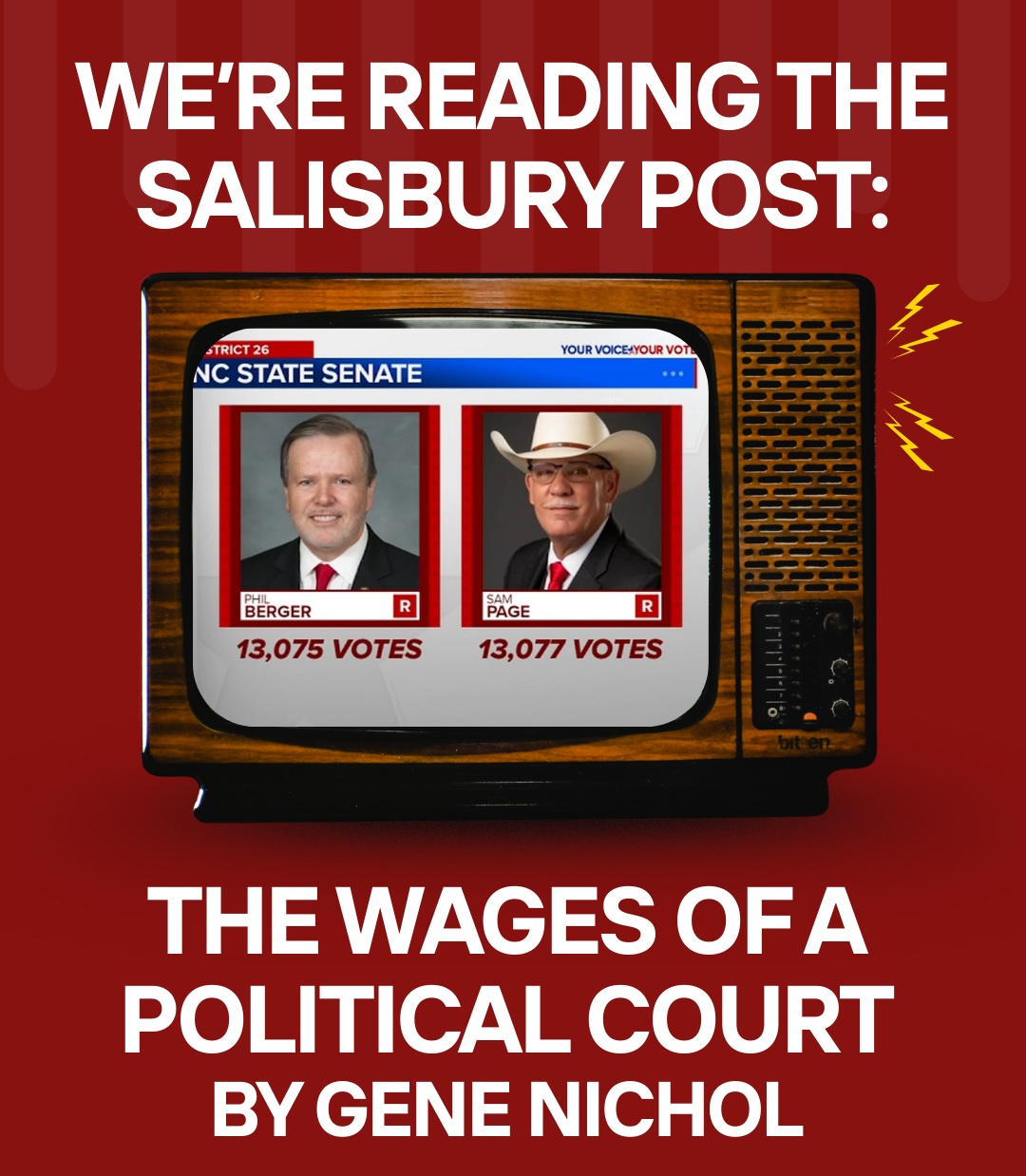
Gene Nichol has been a repeat presenter at RCDP and is a professor of law at the University of North Carolina’s School of Law. Here, he writes about the current political drama surrounding the Berger-Page primary election, and how it’s indicative of the state of our Supreme Court. Read more at: https://www.salisburypost.com/2026/03/08/the-wages-of-a-political-court/
To the surprise of many, including me, Rockingham County Sheriff Sam Page outpolled powerful Senate leader Phil Berger by two votes last Tuesday. The world never fails to astonish.
There is, nonetheless, still much to come: provisional vote certifications, official canvasses, recounts, election challenges, lawsuits, etc. Much will be pursued and much contested. Page has already asked state Auditor David Boliek to recuse himself — since he reportedly campaigned for Berger outside an early voting site in Rockingham County. “The optics just don’t look good,” Page explained. If past is prologue, any election challenge will find its way to the North Carolina Supreme Court.
There’s the rub.
Since January 2023, the N.C. Supreme Court has demonstrated itself to be the most politicized judicial tribunal in the United States. So, one wonders, what is to happen now?
To recall.
Almost immediately after assuming power, the new Republican majority cast 200 years of procedure to the wind and changed North Carolina law to embrace extreme partisan gerrymandering. Chief Justice Paul Newby wrote, absurdly, that our state constitutional guarantee that “all elections shall be free” doesn’t mean they have to be “fair.” Rigged elections are still free. Yeah.
The next year, the court intervened in the presidential election to aid Donald Trump. Robert F. Kennedy Jr. had withdrawn from the race and belatedly sought to have his name removed from the ballot after three million ballots had been printed. Trump folks worried Kennedy might draw away votes. The election board followed state law — refusing an immensely expensive re-printing which would also delay absentee voting. The Republican justices, without basis, simply overturned the board decision. This time Republican Justice Richard Dietz refused to go along with his hyper-partisan colleagues, writing: “I believe this court’s role is to follow the law as written.” Apparently not.
Then, famously, the Republican high court manipulated the review process and upheld, in explicit violation of the North Carolina constitution, Phil Berger’s partisan capture of the state election board. Democracy North Carolina’s director explained: “This version of the court has shown time and again it is not following the law for the people but for the party.” And after hurriedly interjecting itself into the Leandro public schools case, Newby’s Court has inexplicably (and historically) delayed a decision for over 700 days. No one knows why. But the reason is undoubtedly political, not legal.
And this too long list doesn’t include the most stunning political intervention of all — the N.C Supreme Court’s brazen attempt to steal the Allison Riggs’ election on behalf of their buddy Jefferson Griffin. Eventually, of course, a Trump-appointed federal judge stepped in to stop it — noting the Republicans sought to “alter the rules of an election after the fact and apply those changes retroactively to only a select group of voters.” No one could seriously have thought American constitutional law allowed that. But our Republican justices did apparently think they weren’t required to obey it.
Our Supreme Court justices swear an oath not only to support the federal and state constitutions but to “administer justice without favoritism to anyone.” No one honestly believes they do that.
So, in truth, the four hideously partisan Republican members of the N.C. Supreme Court have destroyed the tribunal as an institution. It delivers only partisanship, not justice. Its mantle is politics, not law. That means when the Berger-Page election is delivered to their doorstep none can be expected to believe what they say. Even if Phil Berger’s boy recuses himself — which, of course, he might not. He hasn’t followed the rules so far. Why now? There are high costs to becoming a politically corrupted tribunal. We’re now, once again, about to pay them.
Gene Nichol is a professor of law teaching courses in the constitution and federal courts at the University of North Carolina School of Law.
Originally published at https://www.salisburypost.com/2026/03/08/the-wages-of-a-political-court/