
The ‘Safeguard American Voter Eligibility’ (SAVE) Act is a proposed federal law that would require people to provide proof of citizenship when registering to vote in elections or updating their voter registration. Sounds… fairly normal, maybe, but there’s a lot more to it than there seems.
Currently, most states allow voter registration through online systems, mail-in forms, or third-party (such as the Rowan Democrats) registration drives and events. These options make it easy for someone to register to do their civic duty by voting, but the SAVE Act would make significant changes to this process. Under the proposed bill, people would need to provide proof of citizenship to simply be allowed to vote – which is a problem. For instance, do you know where your proof of citizenship is? Do you have a passport, a certified birth certificate, or a naturalization certificate that you can easily find?
For many Americans, that answer is no. Voting rights organizations across the country estimate that over 21 million voting-age citizens don’t have ready-to-show proof of citizenship. Not only that, but people under the federal ‘poverty line’ are more than twice as likely to lack these documents, despite being otherwise eligible to vote.
Passports, for example, cost money. Obtaining a passport requires transportation, and it requires time taken away from work, kids, or other vital activities – and sometimes, that’s not possible. For someone living paycheck-to-paycheck, that may not be an expense their household can bear (and that essentially makes it a poll tax, which has been illegal since 1965). In some states, as few as 20% of residents even have a passport to begin with.
To ask our first question, we turn to the Brennan Center, which states –
“The bill would functionally eliminate mail registration by requiring voters registering by mail to produce citizenship documents ‘in person’ to an election official before the registration deadline. It would also abolish many or all voter registration drives and online voter registration systems, which are typically treated like mail registration. (Moreover, the bill does not contemplate copies or electronic records of citizenship documents.) And it would severely hamper automatic voter registration, as many of those transactions don’t occur in person while someone has citizenship documents with them.”
So the question we have now to ask is – why would Republicans so desperately want to cut out so many voters?
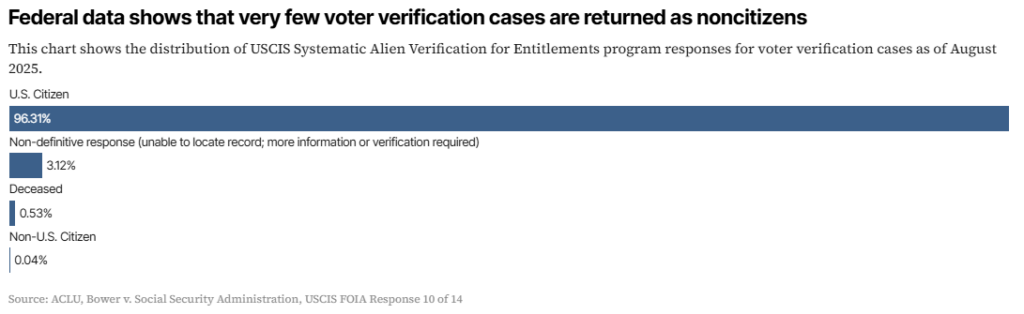
The answer given by supporters of the SAVE Act is fairly deceptive: election security. Supporters argue that requiring documentary proof of citizenship will prevent non-citizens from voting and “strengthen public confidence” in elections. Sure, that would happen – but at what cost? ‘Non-citizen voting’ is already illegal under federal law, and real, documented cases are incredibly rare. Because of that, many voting rights groups say the bill addresses a problem that largely doesn’t exist while creating new barriers for eligible Americans.
On the next group impacted, we have married women. In the United States, a vast majority of women who get married change their last name. However, birth certificates almost always will list a person’s maiden name. If a woman registers to vote under her married name but her birth certificate lists a different one, the documents may not match. In those cases, she may be required to provide additional documentation (such as a marriage certificate) to prove she is who she claims to be, even if it’s fairly obvious. While that may sound simple in theory, in practice, it can mean locating paperwork that may have been issued decades ago, paying fees for replacement documents, or making your way to the local Social Security Office to wait in line. Estimates suggest that tens of millions of American women could have documentation that doesn’t match their current legal identity.
So, that brings up another question – why would Congressional Republicans want to stop married women from voting?
Election administrators themselves have also raised concerns. Local election offices – many of which across our state already operate with limited staff and funding – would suddenly be responsible for verifying and storing millions of additional documents with penalties for errors. The Board of Elections staff would be expected to handle any discovered discrepancies, track paperwork, and manage in-person verification requirements with no additional funding. In places like Rowan County, that could create significant delays and confusion during the voter registration process. By adding the requirement to show citizenship documents, it may entirely eliminate community-based efforts to register voters, adding further to the workload and the burden this bill expects ordinary citizens to bear.
So what’s more important? Election security from a handful of voters, most of whom are caught quickly and reported on in the news, or letting voters actually vote?
As this bill continues to move through Congress, that question will likely continue to be part of the national conversation. The future of American elections hangs in the balance, and it’s our time to act.
You can be part of the movement to help save elections and voter access by calling an elected Senator (Tillis and Budd, here in North Carolina) and asking them to vote no. The vote is coming soon – so time is of the essence.
Key Points:
- Millions of voters lack the required documents to vote under the SAVE Act
- Married women would need to produce proof that their last names have changed
- Online and mail-in voter registration would become essentially impossible
- Low-income, rural, and elderly voters may become unable to vote due to the documentation required and its availability
- This bill is attempting to solve a crisis that doesn’t really exist

Senator Thom Tillis: (202) 224-6342
Senator Ted Budd: (202) 224-3154

Sample call script:
Hello, my name is [Your Name], and I’m a constituent from Salisbury, North Carolina. I live at 123 Democracy Lane.
I’m calling to ask Senator Tillis/Budd to vote NO on the SAVE Act. I’m concerned that the bill would make it harder for eligible citizens to register to vote by requiring documentary proof of citizenship that many Americans don’t have readily available. Millions of voters, including married women with name changes, seniors who may not have easy access to birth records, and naturalized or impoverished citizens who would have to produce difficult-to-replace documents could face unnecessary barriers.
Voting is a fundamental right, and I believe our laws should make it easier for eligible citizens to participate, not harder. Please pass along my request that the Senator vote NO on the SAVE Act.
Thank you for taking my call.