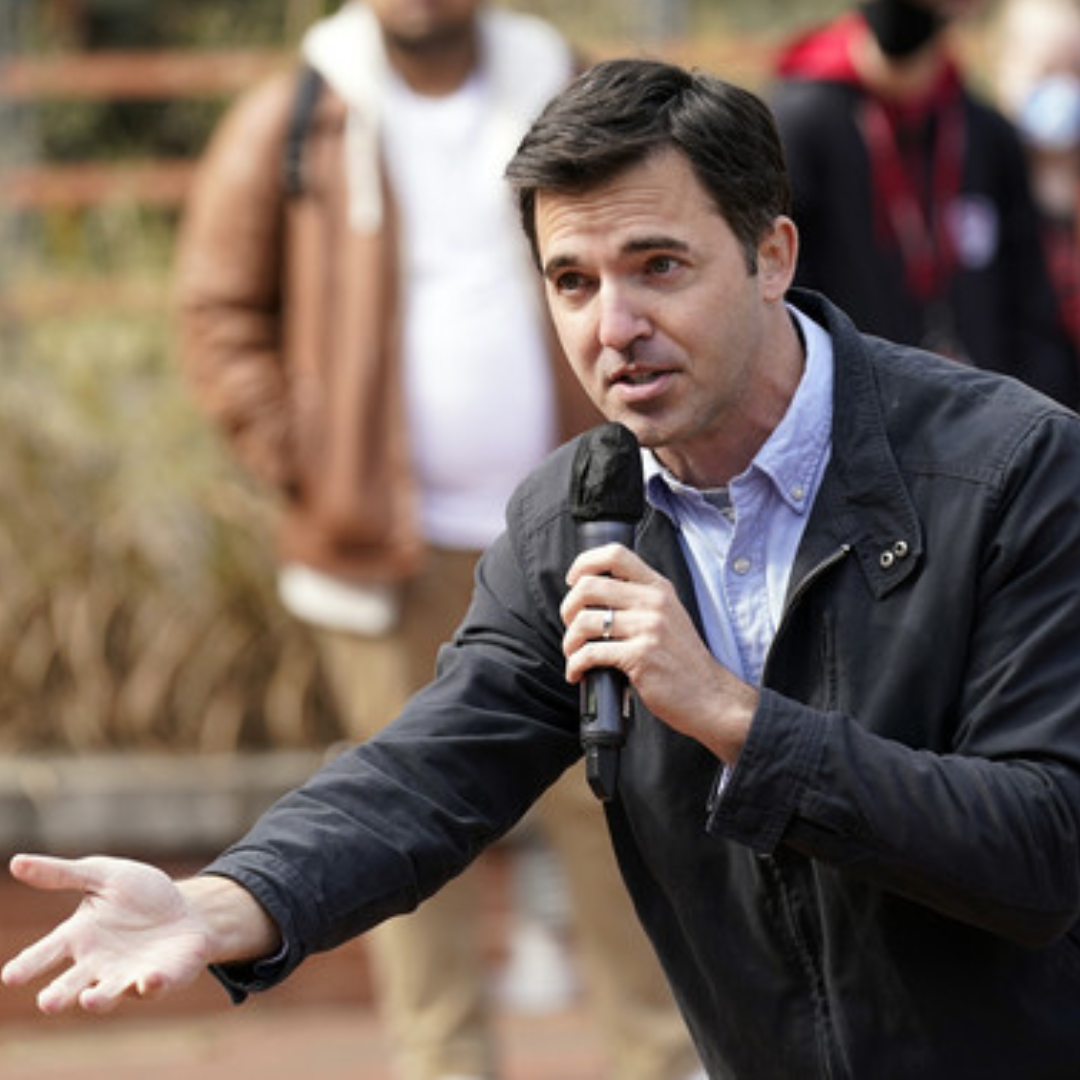
As Jeff Jackson battles Trump, NC GOP threatens to leave him with a ‘feckless, empty shell’ of a job. By Brandon Kingdollar – January 19, 2026
North Carolina Attorney General Jeff Jackson made his name in the U.S. House as the “TikTok Congressman.” Now, he’s again staking out real estate at the technological forefront by heading up a nationwide task force on AI.
Stepping into the attorney general’s office in a year where Trump has sought to halt funding for everything from SNAP benefits to hurricane resilience grants to public school funding — all blocked after court battles that Jackson’s N.C. Department of Justice helped win — the former Congressman has come to view his office as a last line of defense for North Carolinians, both from the executive branch and from the threats of tomorrow.
To lead that defense, he has stressed a united front across party lines. “We are stronger when we speak with one voice,” he told dozens of attorneys general at the AI Task Force’s inaugural meeting last week.
But in his own state, Republicans are vying to strip him of one of his most potent tools: the ability to challenge Trump’s executive orders. The state Senate passed a bill last March that would require the General Assembly to authorize any such lawsuits, and the state House could do the same as it returns for the short session this month.
A term defined by Trump
More than anything else, Jackson’s first year in office has been defined by its lawsuits in defiance of the Trump administration.
Most notably, they won an October court battle that required the Trump administration to disburse $230 million in SNAP benefits to 1.4 million North Carolinians during last fall’s government shutdown. Other successful lawsuits challenged the revocation of more than $165 million in public education funding and $200 million in FEMA resilience dollars.

In Jackson’s view, his office has undertaken a principled approach on executive orders. Whereas some Democratic attorney generals have joined more than 60 lawsuits challenging the Trump administration, his office was only part of 18 in 2025.
“I use an objective formula for when I file a lawsuit against the administration or anyone else,” Jackson told NC Newsline. “Did someone break the law? Did it hurt the state? And can I prove both of those things?”
He has repeatedly stressed that North Carolina’s participation in these lawsuits is often key to recovering blocked funds through court injunctions that only apply to the parties to the lawsuit. Jackson announced in January that his office had recovered a total of $1.5 billion in stalled funds in 2025.
Jackson’s office declined to join some lawsuits against the Trump administration on more divisive issues, particularly around social issues. He did not join, for example, a lawsuit against the Department of Health and Human Services earlier this month challenging an executive order mandating health and education institutions to abide by its definition of biological sex rather than gender identity.
In the view of Western Carolina University political scientist Chris Cooper, “it doesn’t appear that he’s just throwing stuff at the wall to see what sticks.”
“I think he’s choosing cases where he thinks they have a chance to win, and that are going to present as, yes, partisan, but not hyperpartisan and not leaning into the negative,” Cooper said. “What he’s chosen to shoot, he’s been hitting.”
‘AG TikTok’
As the gears began moving on Senate Bill 58, the proposal that would strip Jackson of autonomy on challenges to executive orders, North Carolina Republicans issued a stark warning: Comply or else.
Asked by Sen. Julie Mayfield (D-Buncombe) in February what lawmakers would do if the Attorney General defies a new mandate on executive orders, Sen. Tim Moffitt (R-Henderson) suggested his role could be obliterated by repealing every power granted to it by state law.
“That way, the Attorney General is a feckless, empty shell of a position that has no authority to do anything,” Moffitt said.
Jackson has seemed to draw more ire from Republicans in a single year from Republican state lawmakers than his predecessor, Gov. Josh Stein, did in eight. But he’s also maintained a higher profile than any attorney general before him.
The TikToks that made him famous in Congress have continued — churning out 11 since he entered the attorney general’s office and sharing them across X, Bluesky, Reddit, and Instragram among other platforms.
While they have shifted from the political news dominating Congress to the lawsuits his office is taking on, they have at times retained an adversarial tone — directed at those his office is probing.
“Hi. This message is for WeChat,” he said in a video in May. “You are the second-largest texting platform in the world. You’re also heavily implicated in the money laundering that is tied to trafficking fentanyl.”

“The pattern is clear, and your app is at the center of it. So I reached out to some other attorneys general in both parties and asked them to join me in confronting you,” he said. “You’ve known about your role in this for years, and now, so does everyone else.”
In another video, he addressed 37 companies he accused of facilitating robocalls by name. His office has sought to crack down on robocalls routed through North Carolina, winning a court order fining an AI voice provider $5 million for enabling them.
Opponents see moves like these as evidence of showmanship, rather than statesmanship. And it’s made him an outsized target for the animus of North Carolina Republicans.
Senate President Pro Tem Phil Berger, in comments on social media in October, linked S58 to Jackson’s social media stardom directly — retweeting a radio host who derided Jackson as “AG TikTok.”
“This is exactly why Senate Republicans passed a bill to restrict Jeff Jackson from filing frivolous lawsuits against @POTUS,” Berger wrote. “The AG should be focused on working for the people of NC, not his social media followers.”
In his meetings with Republicans, Jackson has stressed that he wants to lead the state DOJ without partisanship.
“I think it deserves to be done in a nonpartisan way. That was how I campaigned,” Jackson said in an interview with NC Newsline. “I told people that this job has to be about the protection of people and not a political party, and that’s what I believe, that’s how I’ve tried to lead the office.”
But many in the state GOP see his broadsides against the Trump administration as evidence that his lawsuits are driven by political animus.
North Carolina Republican Party spokesman Matt Mercer said he sees little evidence of Jackson leading in a nonpartisan way. “He seems like he’s chosen to take on that partisan mantle versus trying to find areas of agreement with the Trump administration to enforce the law,” Mercer said.
“He’s not leading on these things. He’s signing on to what attorneys general in California and New York and Illinois are doing,” Mercer said. “He’s just falling in line.”
What Jackson touts as a signature achievement, recovering SNAP benefits for North Carolinians, Mercer argued was unnecessary. “Whose fault was it that we had the shutdown to begin with? It was Jeff Jackson’s party.”
‘Refreshingly bipartisan’
Despite battles with Republicans in his own state, Jackson is set to meet his biggest task of the coming year alongside a member of the GOP: Utah Attorney General Derek Brown, with whom he’s co-chairing the AI task force.
Launching the task force in November capped off a first year in office in which Jackson sought to position himself at the forefront of emerging technological challenges without regulatory answers at a time when, in his view, the federal government has abdicated responsibility.

The Trump administration has not only declined to issue regulations on AI, Jackson noted, but it has also sought to prevent the states from enacting their own. A December order from Trump’s White House promises to “check the most onerous and excessive laws emerging from the States that threaten to stymie innovation,” warning it will revoke funding from states that do not comply.
“In my conversations with state legislators, there’s a general understanding that it would be bad if there was executive action that obsoleted all of the AI-related laws that the state has passed.” Jackson said in the interview. “So far, I will say, the response has been refreshingly bipartisan.”
The task force, which formed just a month before that order, has said its work will continue nonetheless.
“This is a perfect demonstration of why, frankly, the Tenth Amendment matters. States really are laboratories of democracy, and I think we’re faster, we are more nimble,” said Brown, the Utah Attorney General.
Jackson said he believes the risks of leaving AI up to Congress far exceed any downsides of a patchwork approach between the states.
“You really don’t want to end up in a situation where the state safeguards have been swept away and then the federal government does nothing, which is the most likely outcome here, as we saw with social media, as we’ve seen with the internet privacy, even for kids,” he said.“The most likely outcome for congressional response to massive new technology is to do virtually nothing.”
He said he hopes to focus on digital hazards like voice cloning, deep fakes, and AI robocalls. His office has also paid special focus to e-commerce. In 2025, his office made inquiries into leading “buy now, pay later” platforms as well as the online commerce giant Shopify. Jackson also called out fraudulent websites and Instagram ads that go to fake companies as sources of concern for his office in the interview with NC Newsline.
‘The leader of an institution’
Jackson’s stint as attorney general is his first time engaging with the public in an executive, rather than legislative, role. It’s also the first time North Carolinians have seen him attempt to shed partisan colors after years of viral TikToks condemning state Senate and U.S. House Republicans.
In a November leadership talk to Duke students and faculty named for former Gov. Terry Sanford, Jackson stressed the importance of reaching out to Republican attorneys general and state lawmakers. Those conversations, he said, are crucial in a time of stark polarization.
“If all I did was diminish some antagonism, that’s worth it. If I took someone from 100% opposed to 70%, y’all, that’s a win,” Jackson said at the Duke forum. “We get out of a lot of meetings being like, I don’t think he hates me. I think he dislikes me!”

His military background has informed his executive leadership style, leading him to seek out “mission-driven” team members and taking a person-to-person approach with as many members of his staff as possible. “You’ve got to give them a sense of who you are.”
That experience, he said, led him to post up at the NCDOJ entrance with his 10-year-old son on his first day and shake hands with every employee who walked in. He also joined a sunrise workout of basic law enforcement training cadets in Asheville, which he also saw as an effort to better understand criminal justice in the state at the ground level.
“What is Jeff Jackson really trying to do in all of this? Is he trying to position himself to run for U.S. Senate in 2028, or for governor in 2028 or 2032, or is he trying to do his job?” asked Mercer, the GOP spokesman.
For his part, Jackson said he does not wish to leave his current role any time soon. When asked in an interview with NC Newsline whether he was considering a Senate run, he said, “Nope.”
“This job is wonderful in what you can actually accomplish. And in that respect, it’s very different than serving in Congress,” he said. “As attorney general, you can make a big difference every day.”
https://ncnewsline.com/2026/01/19/jeff-jackson-trump-lawsuits-2025